Monday, February 24, 2014

Baron Ch. 4: Graphology

This chapter centered on a person's handwriting and what it can indicate about them. The discussions of how writing is taught (or not) in school and graphology were the two topics that stood out to me the most from these chapters.


When I was in elementary school, we spent about a day a week in a computer lab learning how to type. There was this game we played that involved typing to fly a spaceship through space that taught us where to place our fingers (I still place mine "wrong" but it works for me). My earliest memories of writing on a computer were in this lab, as early as third grade, when we had to type a report about one of the past Presidents of the United States. I chose Andrew Jackson because my family is distantly related to him. These early experiences were the death of my handwriting and our generation's emphasis on typing over writing is certainly notable. They aren't even teaching cursive in schools anymore because people consider it a waste of time.


 Personally I find it a little scary that a potential employer might say no to me based on my handwriting alone because my penmanship is especially terrible. If I'm writing at my own pace, say a grocery list or something, it usually turns out somewhat legible, but if I'm writing notes for a class where the professor goes through entirely too quickly, forget about being able to read it. I've tried to remedy it by slowing down and practicing several different strokes, but to no avail. I think my hands shake too much. I wouldn't want a graphologist hired by a firm to look at my handwriting and think "hmm, maybe she's neurotic" or something equally as horrible just because my penmanship stinks.

I did find the general topic of handwriting and the National Handwriting Day particularly interesting however because everyone's handwriting is distinctive and it is something that can be an asset in any workplace.

Sunday, February 9, 2014

Baron Ch. 2: TeknoFear and the Novel

This chapter discusses a couple nutjobs who feared the written word and computers so much that they either blew people up (Unabomber) or smashed a computer on stage. This was interesting because new technology is usually heralded by society as an advancement, not a detriment, and these people made the technology very negative.

I remember having to read books to earn points in elementary school. At the beginning of each year we took an exam on a computer in the library and it spat out our reading level, which was coded with colored stickers on the spine of books in the library. Each month, we were to read a certain number of books on our reading level and take comprehension tests on these same computers. Then we were awarded points for the number of questions we got right and these points could be traded in for toys and candy. This was one heck of a way to get the students to read and I began to think of reading as a kind of game and I read a lot, which continued throughout my high school years.


Because of this memory, I found the part about the book or novel as a written technology to be particularly enlightening because I read a lot of the 'banned' or otherwise criticized books as a kid. I read Harry Potter and I read The Catcher in the Rye and a few others that probably were considered thematic for my age group, probably because I tested on a reading level four years beyond my age. I gravitated towards things that challenged social norms (particularly sci-fi dystopian novels like the Uglies series by Scott Westerfeld) and often included sexual content that might have been considered beyond my years.


I can somewhat sympathize with those who think of books as a 'danger' but I also know that reading such content didn't make me morally depraved or drive me to do crazy things; they just challenged me to think about the world in a different way. I can understand why Baron would consider banning books a form of TeknoFear after thinking through my own experiences.


Sunday, February 2, 2014

Lupton: Learning About Fonts

The Lupton reading had a lot of interesting points and taught me a lot about fonts and their evolution of use. For instance, I didn't know that some of the humanist fonts are named after 15th and 16th century printers. I also learned a lot about the anatomy of the fonts and how to describe them, which will be useful for the typeface essay.

I liked the pictures and graphics that described the different fonts used in print advertising and how each font differs. I liked that the reading included a page devoted to showing the visual difference between a bunch of different fonts because it gets a little hard to visualize them mentally if they aren't displayed all together like that.

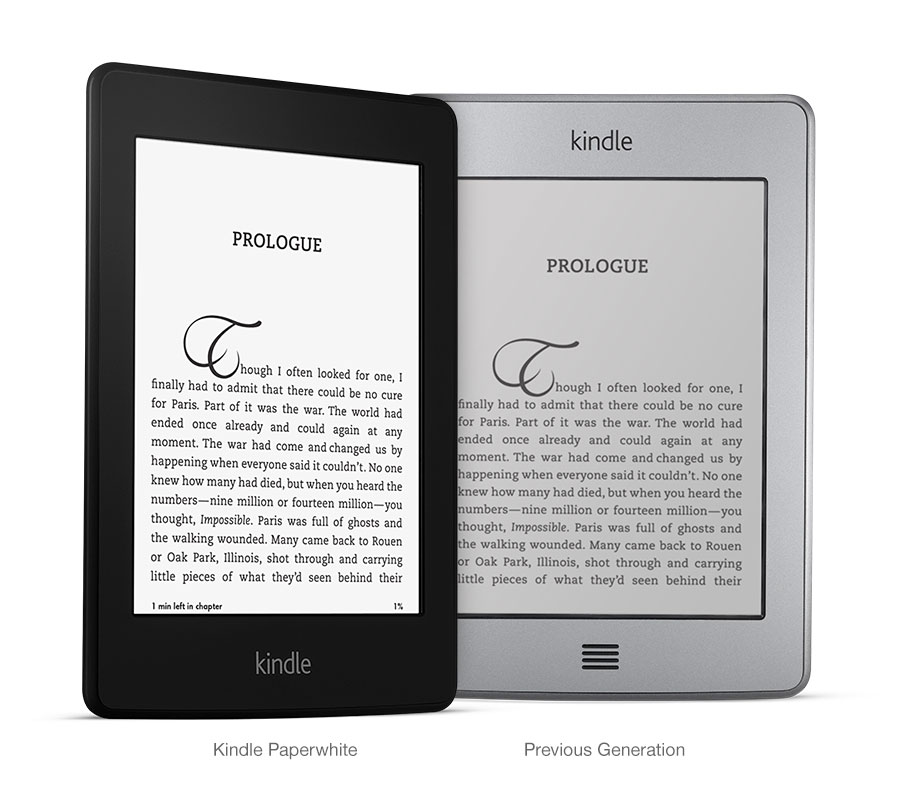
I was most interested in the fonts used after 1990 for the explicit purpose of on-screen use. I thought about the evolution of the personal computer, and I remembered things like the PalmPilot and LeapPad that I used as a kid. I also thought about the ereader and Amazon's development of the e-paper technology and its improvement on the readability of the Kindle, especially in its inclusion of customizable fonts on the Paperwhite. I'm more of a traditional book reader myself, but my parents bought a Paperwhite over the summer and I used it a lot when we went to the beach. I found it to be a very useful device and once I finished a book I was able to instantly download a new one from my county library, which was easily my favorite feature.


My ability to read the family Paperwhite was made possible by the grassroots evolution of fonts and printing that Lupton talks about in this reading. I never would have thought to look something like that up on my own because I never considered fonts to be that big of a deal, and now I know some of the implications of their use and how to accurately describe them in my writing.