Monday, April 7, 2014
Shirky: Blogging is an Asset
I love to write. One thing that frustrated me with Clemson was that they allowed me to declare a writing minor (read: journalism) but then didn't offer any of the courses required to satisfy it, so I ended up having to fill out course substitutions for courses only loosely associated with the minor. It turned out fine and I'll still be able graduate with a writing minor, but the short version of the story is that Clemson decided that the art of journalism was obsolete and was in the process of eliminating it when I declared it, and I didn't quite understand why.
Now I know why: the Internet has eliminated the need for traditional journalism. This article is interesting to me because even though I knew this in the back of my mind, I never considered that the Internet would do anything but help the industry. I don't know when this article was published but I do I think there is a value in creating things like blogs to showcase your skill as a writer.
As a senior working towards finding a job in the media industry, one of the requirements for a lot of the job applications I've been filling out have been that I include links to thinks like blogs and Twitter to show my skill as a writer. I have a marketing agency in San Francisco that is interested in hiring me as an intern based almost completely on the links I sent and writing samples from the various blogs and related media I've contributed to. One thing to note as well is that it's a major asset to have experience with WordPress and Adobe publishing suite when applying for positions, especially out of college. I have to think that these industries are now adopting an attitude of "if you can't beat them, join them" and are using the availability and accessibility of the Internet to find worthwhile employees and build strong teams. For this reason, I truly believe that writing online (tastefully, of course) is a smart choice in increasing one's marketability and creating a portfolio, and I think the Internet has allowed us to reach this point.
Monday, March 31, 2014
Rheingold: Protecting the Hacker
There is a fine line between responsibly disclosing something that could be potentially dangerous in the wrong hands and potentially getting in trouble for crossing a line. Last semester, my ex boyfriend Kyle found a fatal flaw with the ePortfolio program that Clemson didn't want us to know about: he figured out a way that one could hack into the system and completely ELIMINATE everyone's portfolios like they never existed. He sat on this information for about a week before finally emailing someone he trusted over at CCIT (he used to work there) and saying, essentially, don't shoot the messenger but I found a major bug and you should fix it before we all get screwed. This was a couple of weeks before he was set to graduate and he had major misgivings about telling anyone in case they somehow used this as a reason to expel him.
The ePortfolio is a major headache for most Clemson students, especially those who are about to graduate and either have failed it or haven't gotten their grades back. Imagine if someone besides my ex had found that flaw and had the ability to erase such a thing so close to graduation - it would have been chaos. And what if they never found the guy? These are reasons why I like the idea of the EFF because if there's a team out there who can search and destroy these types of 'villians' we're all safer for it. And, actually, Kyle now works for GE's IT department in Richmond essentially defensively hacking for the company so that they can avoid major disaster, such as confidential information getting into the wrong hands. In a way he sort of bends the law to benefit the company. The EFF would protect his rights to do so, which I think is important not only for him and for GE but also for the greater good. The most important thing to gather from this reading I think is the idea that the average Internet user is not a criminal.
Thursday, March 20, 2014
Inattention Span (Carr 7)
This chapter from The Shallows grabbed my attention when it talked about how our use of the Internet can literally shape our brain functions both positively and negatively. I know my attention span is very short when I'm online (or too long if I'm on Buzzfeed or The Oatmeal) and I can get fatigued when I'm reading through a long article or some other site because I'm constantly thinking about what's on the screen. I'd be interested to know what my reading comprehension score would be after years of Internet use versus when I was a kid and if it has decreased.
I was also interested in the thought that teenagers are afraid of being disconnected, maybe more than they were when I was one. I had the luxury of having an Apple iBook 8th grade through high school in all of my classes, which allowed me to take notes on my computer, type assignments up quickly, surf the web... and be signed on to iChat/AIM constantly, all day, every day, until they found a way to block it (which I quickly found a way around). What this meant was whenever my computer was open, I was sending messages over the Internet to my classmates, family, or friends. I remember feeling like I needed to be in constant contact, even when it meant getting a detention once or twice because I got caught. I didn't think anything negative of it. Now, when I look at my 15 year old cousin who is never more than two feet from her cell phone, I can't help but consider that it's the same thing as my AIM addiction, just grown up. I might criticize her for not being able to put her phone down during dinner, SnapChat can wait, but it's the same as me being logged on during class: I should have been more present than I was. I think the main point I'll take away from this reading is that there is value in being able to focus on one given task at a time and be present in the moment, rather than constantly checking to see the next update.
Monday, March 10, 2014
We're All Hopelessly Addicted to the Internet (Carr 5)
This is a commercial for the Windows phone that satirizes how people use their phones too much and I'm posting it here because it made me laugh and I think it serves as a decent introduction to my blog post for this week because the reading discussed not only how much people use the Internet in general but also on their phones.
While reading this article I originally thought of a commercial from a few years ago that showed someone holding a bunch of media (books, movies, music, a dictionary...) and then said something along the lines of: "You could carry all of this around with you... or you could buy this Smartphone." But the trick is remembering which Smartphone they were advertising and then finding the video. The one above however does demonstrate the central idea that we spend entirely too much time with each of our Internet-enabled devices shoved in our faces.
The part of this chapter that I was most surprised by was concerned with how different places use technology, in which ways, and for how long, on average. I don't think these numbers are too surprising considering how much these devices have evolved even just over the past 10 years and how quickly (think Motorola Razr phone, which I was psyched to get in 9th grade, versus an iPhone 3 just 3 years later, versus the Samsung Galaxy Tab this year...) and how much texting has replaced face-to-face or phone calls mostly out of convenience (T9 vs. a full touch-screen keyboard).
The Internet and all the devices that use it are endless and present endless possibilities for the limited time we're awake in a day, and these possibilities are always changing. A friend of mine showed me this tonight and I lost about an hour playing it. The link is to a game called 2048 that is essentially a math game that uses an algorithm that generates two 2's and you move like numbers around trying to get a final score of 2048 in the boxes. It's simple but incredibly addicting and just shows how our Internet time can disappear quickly as the chapter discusses.
Wednesday, March 5, 2014
Baron, Ch. 10: A Space of One's Own
The idea of the Internet becoming a space to use as one wishes is a lesson I had to learn young. I, like many other 12-15 year olds, had a Xanga in middle school, which was really my first experience with an online blog or ediary. I didn't tell my parents about it and of course they found it and read EVERY single post. Including ones in which I lamented being grounded or "my stupid parents" or something equally as juvenile. The conversation quickly turned into the implications of my use of these sites (MySpace was just starting, Facebook was for college students with .edu emails only at this point) and whether or not my computer should be loaded with parental guidance software, which of course I found very offensive and a complete invasion of privacy.
Now that I'm older, however, I notice that kids start logging on much younger than I did and they begin posting on these sites in ways that could potentially be dangerous. I have two female cousins, 15 and 10, who are online every day. My aunt knows their passwords and it's required that they remain friends with several adults in the family so that they can have someone keeping an eye on them, which is pretty important. It removes the temptation to think of these sites and the content we post on them as any kind of private, because they just aren't, and that's a hard lesson to learn, especially when you're young.
I think our social media encyclopedia collection has the potential to illuminate some of these issues for new internet users because if one looks carefully through the fine print on some of these sites it defines the rules for which we have to operate, which is important.
Now that I'm older, however, I notice that kids start logging on much younger than I did and they begin posting on these sites in ways that could potentially be dangerous. I have two female cousins, 15 and 10, who are online every day. My aunt knows their passwords and it's required that they remain friends with several adults in the family so that they can have someone keeping an eye on them, which is pretty important. It removes the temptation to think of these sites and the content we post on them as any kind of private, because they just aren't, and that's a hard lesson to learn, especially when you're young.
I think our social media encyclopedia collection has the potential to illuminate some of these issues for new internet users because if one looks carefully through the fine print on some of these sites it defines the rules for which we have to operate, which is important.
Monday, February 24, 2014
Baron Ch. 4: Graphology
This chapter centered on a person's handwriting and what it can indicate about them. The discussions of how writing is taught (or not) in school and graphology were the two topics that stood out to me the most from these chapters.
When I was in elementary school, we spent about a day a week in a computer lab learning how to type. There was this game we played that involved typing to fly a spaceship through space that taught us where to place our fingers (I still place mine "wrong" but it works for me). My earliest memories of writing on a computer were in this lab, as early as third grade, when we had to type a report about one of the past Presidents of the United States. I chose Andrew Jackson because my family is distantly related to him. These early experiences were the death of my handwriting and our generation's emphasis on typing over writing is certainly notable. They aren't even teaching cursive in schools anymore because people consider it a waste of time.
Personally I find it a little scary that a potential employer might say no to me based on my handwriting alone because my penmanship is especially terrible. If I'm writing at my own pace, say a grocery list or something, it usually turns out somewhat legible, but if I'm writing notes for a class where the professor goes through entirely too quickly, forget about being able to read it. I've tried to remedy it by slowing down and practicing several different strokes, but to no avail. I think my hands shake too much. I wouldn't want a graphologist hired by a firm to look at my handwriting and think "hmm, maybe she's neurotic" or something equally as horrible just because my penmanship stinks.
I did find the general topic of handwriting and the National Handwriting Day particularly interesting however because everyone's handwriting is distinctive and it is something that can be an asset in any workplace.
When I was in elementary school, we spent about a day a week in a computer lab learning how to type. There was this game we played that involved typing to fly a spaceship through space that taught us where to place our fingers (I still place mine "wrong" but it works for me). My earliest memories of writing on a computer were in this lab, as early as third grade, when we had to type a report about one of the past Presidents of the United States. I chose Andrew Jackson because my family is distantly related to him. These early experiences were the death of my handwriting and our generation's emphasis on typing over writing is certainly notable. They aren't even teaching cursive in schools anymore because people consider it a waste of time.
Personally I find it a little scary that a potential employer might say no to me based on my handwriting alone because my penmanship is especially terrible. If I'm writing at my own pace, say a grocery list or something, it usually turns out somewhat legible, but if I'm writing notes for a class where the professor goes through entirely too quickly, forget about being able to read it. I've tried to remedy it by slowing down and practicing several different strokes, but to no avail. I think my hands shake too much. I wouldn't want a graphologist hired by a firm to look at my handwriting and think "hmm, maybe she's neurotic" or something equally as horrible just because my penmanship stinks.
I did find the general topic of handwriting and the National Handwriting Day particularly interesting however because everyone's handwriting is distinctive and it is something that can be an asset in any workplace.
Sunday, February 9, 2014
Baron Ch. 2: TeknoFear and the Novel
This chapter discusses a couple nutjobs who feared the written word and computers so much that they either blew people up (Unabomber) or smashed a computer on stage. This was interesting because new technology is usually heralded by society as an advancement, not a detriment, and these people made the technology very negative.
I remember having to read books to earn points in elementary school. At the beginning of each year we took an exam on a computer in the library and it spat out our reading level, which was coded with colored stickers on the spine of books in the library. Each month, we were to read a certain number of books on our reading level and take comprehension tests on these same computers. Then we were awarded points for the number of questions we got right and these points could be traded in for toys and candy. This was one heck of a way to get the students to read and I began to think of reading as a kind of game and I read a lot, which continued throughout my high school years.
Because of this memory, I found the part about the book or novel as a written technology to be particularly enlightening because I read a lot of the 'banned' or otherwise criticized books as a kid. I read Harry Potter and I read The Catcher in the Rye and a few others that probably were considered thematic for my age group, probably because I tested on a reading level four years beyond my age. I gravitated towards things that challenged social norms (particularly sci-fi dystopian novels like the Uglies series by Scott Westerfeld) and often included sexual content that might have been considered beyond my years.
I can somewhat sympathize with those who think of books as a 'danger' but I also know that reading such content didn't make me morally depraved or drive me to do crazy things; they just challenged me to think about the world in a different way. I can understand why Baron would consider banning books a form of TeknoFear after thinking through my own experiences.
I remember having to read books to earn points in elementary school. At the beginning of each year we took an exam on a computer in the library and it spat out our reading level, which was coded with colored stickers on the spine of books in the library. Each month, we were to read a certain number of books on our reading level and take comprehension tests on these same computers. Then we were awarded points for the number of questions we got right and these points could be traded in for toys and candy. This was one heck of a way to get the students to read and I began to think of reading as a kind of game and I read a lot, which continued throughout my high school years.
Because of this memory, I found the part about the book or novel as a written technology to be particularly enlightening because I read a lot of the 'banned' or otherwise criticized books as a kid. I read Harry Potter and I read The Catcher in the Rye and a few others that probably were considered thematic for my age group, probably because I tested on a reading level four years beyond my age. I gravitated towards things that challenged social norms (particularly sci-fi dystopian novels like the Uglies series by Scott Westerfeld) and often included sexual content that might have been considered beyond my years.
I can somewhat sympathize with those who think of books as a 'danger' but I also know that reading such content didn't make me morally depraved or drive me to do crazy things; they just challenged me to think about the world in a different way. I can understand why Baron would consider banning books a form of TeknoFear after thinking through my own experiences.
Sunday, February 2, 2014
Lupton: Learning About Fonts
The Lupton reading had a lot of interesting points and taught me a lot about fonts and their evolution of use. For instance, I didn't know that some of the humanist fonts are named after 15th and 16th century printers. I also learned a lot about the anatomy of the fonts and how to describe them, which will be useful for the typeface essay.
I liked the pictures and graphics that described the different fonts used in print advertising and how each font differs. I liked that the reading included a page devoted to showing the visual difference between a bunch of different fonts because it gets a little hard to visualize them mentally if they aren't displayed all together like that.
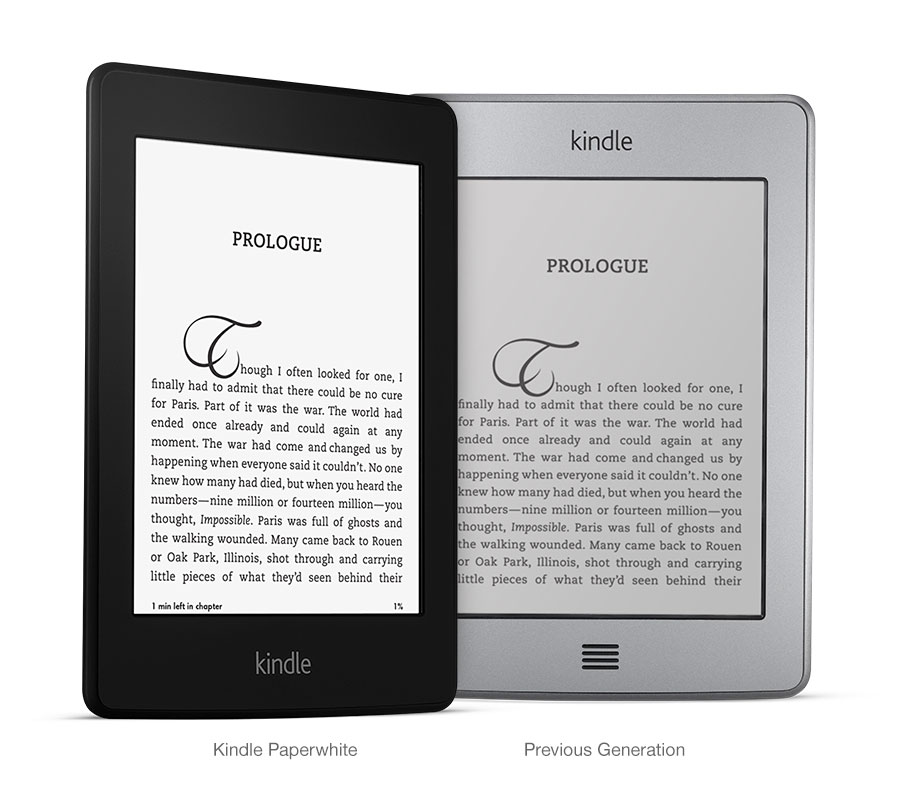
I was most interested in the fonts used after 1990 for the explicit purpose of on-screen use. I thought about the evolution of the personal computer, and I remembered things like the PalmPilot and LeapPad that I used as a kid. I also thought about the ereader and Amazon's development of the e-paper technology and its improvement on the readability of the Kindle, especially in its inclusion of customizable fonts on the Paperwhite. I'm more of a traditional book reader myself, but my parents bought a Paperwhite over the summer and I used it a lot when we went to the beach. I found it to be a very useful device and once I finished a book I was able to instantly download a new one from my county library, which was easily my favorite feature.
My ability to read the family Paperwhite was made possible by the grassroots evolution of fonts and printing that Lupton talks about in this reading. I never would have thought to look something like that up on my own because I never considered fonts to be that big of a deal, and now I know some of the implications of their use and how to accurately describe them in my writing.
I liked the pictures and graphics that described the different fonts used in print advertising and how each font differs. I liked that the reading included a page devoted to showing the visual difference between a bunch of different fonts because it gets a little hard to visualize them mentally if they aren't displayed all together like that.
I was most interested in the fonts used after 1990 for the explicit purpose of on-screen use. I thought about the evolution of the personal computer, and I remembered things like the PalmPilot and LeapPad that I used as a kid. I also thought about the ereader and Amazon's development of the e-paper technology and its improvement on the readability of the Kindle, especially in its inclusion of customizable fonts on the Paperwhite. I'm more of a traditional book reader myself, but my parents bought a Paperwhite over the summer and I used it a lot when we went to the beach. I found it to be a very useful device and once I finished a book I was able to instantly download a new one from my county library, which was easily my favorite feature.
My ability to read the family Paperwhite was made possible by the grassroots evolution of fonts and printing that Lupton talks about in this reading. I never would have thought to look something like that up on my own because I never considered fonts to be that big of a deal, and now I know some of the implications of their use and how to accurately describe them in my writing.
Sunday, January 26, 2014
The Power of the Written Word
Rather than focus specifically on the work itself, I’d
prefer to respond to the overall idea that the written word itself is powerful
and useful for our lives. Plato’s Phaedrus
suggests that there is power in the ability to write. It conveys history,
laws, intention, and human communication. It can communicate directions or
teach as well as provide a physical manifestation of faith.
I’ve read
many different articles about the human experience in studying communication
studies at Clemson. I remember one article in particular that we studied my
sophomore year in a qualitative research methods course. It was an ethnographic
study of a male strip club called “The White Swallow.” It stuck with me because
it was a written account of the experiences of the men who worked or regularly
visited this club. It was studied by a straight man seeking to be a participant
observer for a period of five months. I think this is applicable to the Phaedrus reading because it is a written
documentation of the experiences of real people who work or visit this establishment
and allows someone who would probably never have known what it was like to go
to a gay strip club to know what it is like to be in that place, similar to the
way Phaedrus tells his stories in the reading.
There’s
major value in studying human experience through the human word, especially if
you’re involved in a social science. Often the best way to learn something is
to read a first-hand account, which is probably why I can remember my experience
with the strip club article two years later, even though I usually can’t
remember such specific details a week later when I read a chapter of a
textbook.
Monday, January 20, 2014
Artificial Writing
The chosen Boorstin reading focused on the life and work of Johan Gutenburg
and his invention of the printing press. It discusses the colorful life that
Gutenburg lived, lawsuits he was involved in, and perceptions others held of
him and of his work. The most interesting section for me was the part about the
process Gutenburg went through in inventing the press and the specific
considerations he made to ensure that the letters were about the same width and
height and the different inks he used.
The printing press was the first
step in producing our literate society and had huge implications for the way we
communicate. Without the press, we wouldn’t have had the movable type, which
led to newspapers. A modern example of this technology is the computer or phone keyboard. It has individual keys just
like the press did and allows the written word to be mass-produced. One could
argue that Gutenburg’s invention is what allows me to be able to sit here typing
away on this blog. Anyone can be a writer: anyone can “publish” things to the Internet
for all to read on Google’s Blogger, even from my cell phone.
Subscribe to:
Posts (Atom)